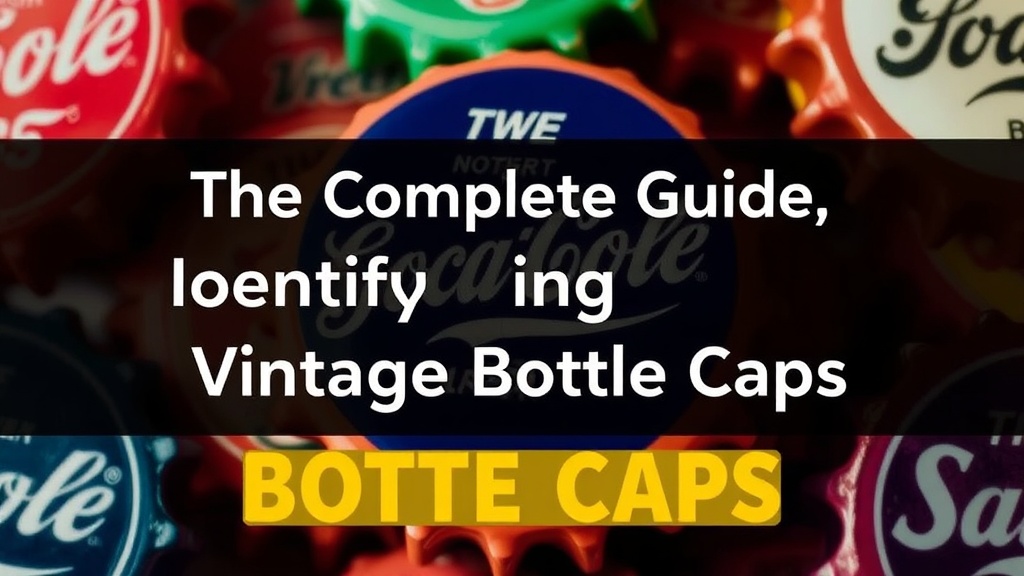
The Complete Guide to Identifying Vintage Soda Bottle Caps

This guide covers the key techniques for identifying authentic vintage soda bottle caps—from distinguishing reproductions to recognizing rare manufacturer marks. Whether sorting through estate sale finds or evaluating a potential purchase, knowing what separates a $0.25 cap from a $250 specimen saves money and builds a collection worth keeping.
How Can You Tell If a Soda Bottle Cap Is Actually Vintage?
The fastest way to identify a genuine vintage cap is by examining the liner material, the crimp edge pattern, and any date codes stamped on the underside. Reproductions flood the market—and they're getting better every year.
Start with the liner. Pre-1960s caps used cork liners bonded to the metal shell. By the late 1960s, most manufacturers switched to PVC or composite liners. If a cap claims to be from 1955 but has a white plastic liner, that's a red flag. The transition wasn't overnight—some regional bottlers held onto cork longer than others—but it's a reliable starting point.
The crimp edge (the ridged skirt around the cap's perimeter) tells another story. Early machine-made caps from the 1920s-1940s typically show 21-24 crimps. Post-1960s caps usually have 28-32 crimps for a tighter seal on modern bottling equipment. Count them. It's tedious but revealing.
Look for manufacturer codes. Companies like Crown Cork & Seal (still operating today) stamped their products with date codes and plant identifiers. The Soda Caps Reference Database maintains a searchable index of these marks. A "CSC" stamp indicates Crown's Baltimore plant—highly collectible if paired with the right brand.
Common Reproduction Markers
Modern repros often get the details wrong. Colors appear too bright (vintage caps fade). The metal feels thinner. And the graphics lack the slight misregistration you'd see on genuine period printing—those tiny overlaps where red bleeds into white.
The catch? Some reproductions are intentionally aged—buried in dirt, exposed to UV light, even soaked in weak acid to simulate patina. These "distressed" fakes target collectors specifically. The acid test (sometimes literally) is the smell: genuine vintage caps carry a faint metallic-cork odor. Reproductions smell like paint or nothing at all.
What Do the Numbers and Letters on Bottle Caps Mean?
Most alphanumeric markings identify the manufacturer, the bottling plant, and sometimes the production date or mold number. These codes weren't standardized—each company developed its own system.
Crown Cork & Seal used a letter-number-letter format through the 1950s. The first letter indicated the plant ("B" for Baltimore, "P" for Philadelphia). The number represented the production line. The final letter denoted the year—"A" for 1950, "B" for 1951, and so on. By 1960, they switched to a two-digit year system that's easier to read.
American Bottle Company (ABC) favored numeric plant codes. A "7" meant Cleveland. "12" indicated Los Angeles. Their date stamps appeared on the liner itself—often hand-inked and now faded to near-invisibility on surviving specimens.
Here's the thing: not all caps have codes. Regional bottlers—especially in the South and Midwest—often used unmarked generic caps supplied by local jobbers. The absence of marks doesn't mean a cap isn't vintage. It might mean it's rarer than the stamped equivalents.
| Manufacturer | Code Format | Era | Example |
|---|---|---|---|
| Crown Cork & Seal | Letter-Number-Letter | 1920s–1959 | B-3-C (Baltimore plant, 1952) |
| Crown Cork & Seal | Letter-Number-Number | 1960s–present | P-12-64 (Philadelphia, 1964) |
| American Bottle Co. | Number only (plant) | 1930s–1960s | 7 (Cleveland plant) |
| Pacific Coast Borax | Two-letter plant code | 1940s–1950s | SF (San Francisco) |
| Local jobbers | None | All eras | Unmarked generic cap |
Some collectors ignore these codes entirely. They focus on brand logos—Coca-Cola, Pepsi, Dr Pepper, the smaller regional sodas. That approach works for display purposes. For valuation, though, the manufacturer data matters. Two identical 7UP caps might differ by $40 depending on whether they came from a Crown plant or an independent jobber.
Which Soda Bottle Caps Are Worth the Most Money?
Rarity drives value—not age alone. A common 1930s Coca-Cola cap might fetch $5. An obscure 1970s regional brand like "Kist Cherry Kola" from a short-lived Mississippi bottler? That could bring $200 or more.
The most valuable caps share common traits: limited production runs, unusual designs, ties to historical events, or connections to defunct brands. Here's what actually sells:
- Prototype caps—test designs never mass-produced. These occasionally surface from former employees' estates.
- War-era caps—soda brands that operated during World War II often used simplified designs due to metal rationing. The "victory caps" with reduced graphics command premiums.
- Errors and misprints—misspelled brand names, inverted colors, double-strikes. The 1954 Dr Pepper cap reading "Dr. Pepper" (with the period) is a famous example—worth $300+ in good condition.
- Regional exclusives—brands like Nesbitt's, Squamscot, or Ski that never achieved national distribution.
Condition matters more than most beginners expect. The International Society of Bottle Cap Collectors (ISBCC) uses a 10-point grading scale. A cap rated "Mint" (10) shows no wear, no scratches, original liner intact. "Fine" (7) allows minor edge wear but no corrosion. Anything below "Good" (4) is essentially a placeholder—worth keeping for reference, not for resale.
Worth noting: never clean a potentially valuable cap with harsh chemicals. Water and a soft cloth suffice. Aggressive cleaning destroys the patina that authenticates age—and can remove the very oxidation patterns that prove a cap wasn't artificially aged last week in someone's garage.
Spotting the Hidden Gems
Halifax-area collectors occasionally find treasures from the Maritime provinces' independent bottlers. Companies like Maritime Beverages (now defunct) produced limited runs in the 1950s and 60s. Their caps rarely appear in price guides—there weren't enough made to establish a market.
That creates opportunity. A "MacDonald's Cola" cap (Halifax-based, operated 1947-1963) might sell for $15 at a local antique shop because the dealer doesn't recognize the name. The same cap at a specialized auction? $80-120. Knowledge pays.
Check estate sales in former bottling towns. New Britain, Connecticut. Columbus, Georgia. Fresno, California. These cities hosted small bottlers that served local markets exclusively. Their caps didn't travel far—meaning they're still found locally, often unrecognized.
How Should You Organize and Store Identified Vintage Caps?
Proper storage prevents the degradation that ruins value. Caps need controlled humidity, stable temperatures, and protection from direct light.
Avoid the classic "jar full of caps" approach. Metal caps touching metal caps creates abrasion. The vibration of moving a jar scrubs graphics off. Instead, use 2x2 cardboard coin holders—the kind stamp collectors use. These hold individual caps safely and allow for labeling.
For display, consider trading card pages in three-ring binders. Each pocket holds one cap face-out. The polypropylene material is archival-safe and won't react with the metal. Avoid PVC pages—they off-gas chemicals that accelerate corrosion.
The environment matters. Ideal conditions run 65-70°F with 40-50% humidity. Basements flood. Attics cook. A closet in a climate-controlled room works best. Toss in a few silica gel packets to manage moisture swings.
That said, some collectors embrace the "as found" aesthetic. They display caps with their original dirt, their rust spots, their bent edges. It's a valid approach—especially for caps with documented provenance. A 1940s Pepsi cap pulled from a construction site in Brooklyn, still caked with authentic 1940s Brooklyn dirt? That's a conversation piece.
"The best collection isn't the biggest. It's the one where every piece has a story you can tell—and prove."
Documentation separates serious collectors from accumulators. Photograph acquisitions. Record where they came from, who sold them, what was paid. This provenance becomes part of the item's value. A documented cap with a clear history commands more than an identical mystery piece.
Whether building a focused collection of Coca-Cola variants or casting a wide net across regional brands, identification skills separate meaningful finds from shelf filler. The bottle cap—once a disposable bit of packaging—carries history in its crimped edges. Learning to read that history turns casual hunting into genuine collecting.